LA2050 Blog
We’ve got access to the information that every Angeleno needs to make an impact. Our blog features the latest LA2050 news, announcements, features, happenings, grantee updates, and more.

Center for Caregiver Advancement is Preparing Caregivers to Respond in Times of Crisis
PostedThroughout the past month, we checked in with our 2025 grantees to learn how their funded programs, projects, and initiatives are progressing – and to better understand the impact they’re making across Los Angeles. Now, we are excited to share these interviews, with stories of growth, challenges, and community transformation. [Find each of their stories here.]
Center for Caregiver Advancement received funding through the LA2050 Grants Challenge from the Goldhirsh Foundation to support its Emergency & Disaster Readiness training for In-Home Supportive Services providers, equipping caregivers with the skills to serve as frontline responders for older adults and people with disabilities. Below is an edited transcript of our conversation with their team.
Interview Participants:
Sabrina Ullah, Chief Program Officer
Andrea Garcia, Director of Programs, Home Care
Blanca Lopez, Program Manager
LA2050: The Center for Caregiver Advancement is equipping In-Home Supportive Services providers with emergency and disaster readiness training, positioning caregivers as frontline responders. How does this training model strengthen outcomes for older adults and people with disabilities, particularly in the face of climate-related emergencies?
The Center for Caregiver Advancement: Our Emergency & Disaster Readiness training strengthens outcomes for older adults and people with disabilities by preparing In-Home Supportive Services providers to respond more confidently and effectively when emergencies happen. Caregivers are often the first, and sometimes only, point of contact for people who are especially vulnerable during wildfires, extreme heat, power outages, and other climate-related events. When they have the tools to recognize risks early, implement safety protocols, plan for emergency evacuations, and adapt care in real time, they can help prevent avoidable injuries, complications, and hospitalizations, and save lives. The training also helps caregivers maintain continuity of care during disruptions, whether that means making sure someone can still access medications, use medical equipment safely, or stay connected to essential services in a rapidly changing situation.
Just as important, the model strengthens communication and trust. Caregivers learn how to communicate clearly with consumers, families, and emergency responders so that people with mobility limitations, cognitive impairments, or language barriers are not overlooked in a crisis. Because these providers are already deeply embedded in the communities they serve, this approach builds on relationships that already exist. That means consumers are receiving support from someone they know and trust during some of the most stressful moments they may experience. For us, that is a major part of resilience: not only having a plan on paper, but having a trained, culturally responsive person there who can help carry it out when it matters most.
LA2050: Given the intersection of workforce challenges, climate vulnerability, and the needs of low-income and disabled populations, how are you navigating these complexities, and what early successes or insights have emerged from the rollout of this training program?
The Center for Caregiver Advancement: As we’ve rolled out the program, one of the biggest things we’ve had to navigate is the reality of caregiving work itself. IHSS providers are balancing unpredictable schedules, multiple responsibilities, and limited time, so we knew from the start that a traditional training format would not work for many of them. That’s why we designed the course as a self-paced, asynchronous e-learning model. We also paired it with stipends and emergency kits, because we wanted to reduce barriers to participation and make sure caregivers could engage with the training in a way that felt realistic and supportive. More broadly, we’ve tried to build a program that recognizes caregivers not only as essential workers, but also as people who may themselves be vulnerable during climate-related emergencies.
We’ve seen really encouraging early signs that this approach is resonating. We received more than 400 applications for 100 spots, which tells us there is real demand for this kind of training. Participants have responded positively to both the flexibility of the format and the relevance of the content. One of the clearest insights so far is that caregivers want training that reflects the full scope of their experience, they need practical tools to support the consumers they serve, but they also want to feel prepared to protect themselves and their own households in a crisis. That has reinforced for us how important flexible, culturally responsive, skills-based training can be in strengthening both workforce development and climate resilience across Los Angeles County.
LA2050: What do you hope to achieve in the last six months of the grant, and how can the broader LA2050 community support?
The Center for Caregiver Advancement: In the final six months of the grant, we’re focused on fully implementing the program and measuring its impact in a meaningful way. That means successfully training 100 IHSS providers in Emergency & Disaster Readiness, continuing to support the current cohort through completion, and potentially launching a second cohort later in the summer, depending on graduation numbers. We’re also tracking knowledge gains, pre- and post-survey data, and how participants apply what they’ve learned around emergency preparedness, communication, and continuity of care. We want to understand not just whether people completed the training, but how it is changing their confidence, their readiness, and their ability to support consumers when emergencies arise.
The broader LA2050 community can support this work by helping us build stronger connections to aligned organizations, public agencies, and emergency response stakeholders so this model can continue beyond the grant period. We’d also really value opportunities to participate in spaces like funder roundtables and other conversations that can help strengthen coordination and long-term sustainability. More broadly, we think there is an important narrative shift needed around caregiving. Caregivers are essential every day, but that becomes especially visible in times of crisis. Support from the LA2050 community in helping uplift that story, and in recognizing caregivers as critical frontline responders in climate emergencies, would make a real difference.
CCA Curriculum In Action
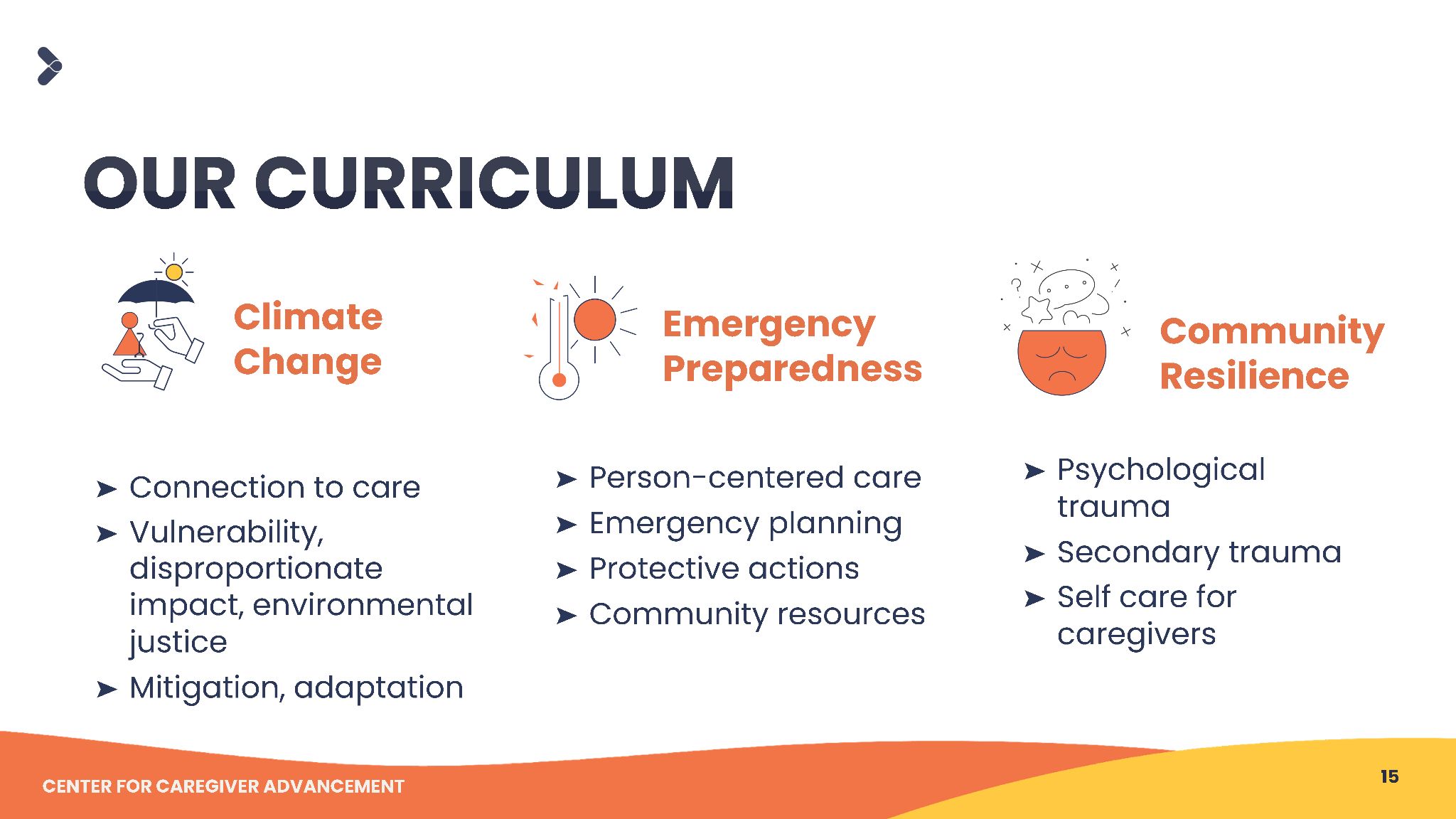
Photo Credit: Center for Caregiver Advancement
At a Glance
- LA2050 checks in with the Center for Caregiver Advancement, a 2025 Grants Challenge winner, halfway through its grant period.
- The Center for Caregiver Advancement is equipping In-Home Supportive Services providers with emergency and disaster readiness training, positioning caregivers as frontline responders.
- One of the biggest things it had to navigate is the reality of caregiving work where providers are balancing unpredictable schedules, multiple responsibilities, and limited time.